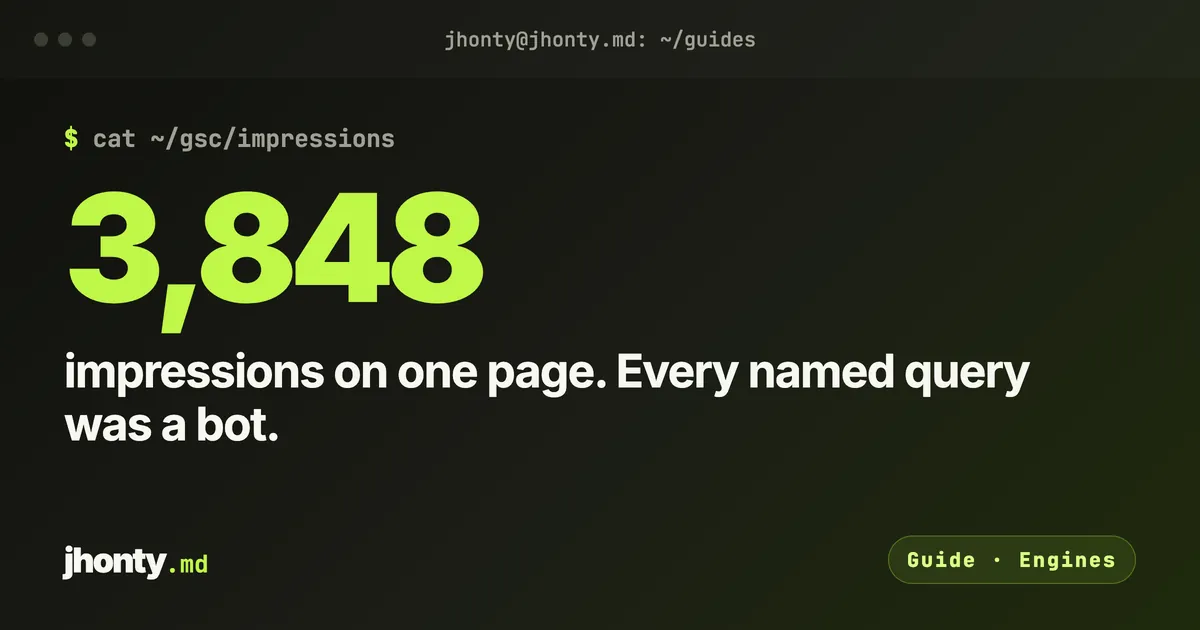
3,848 impressions on one page in 90 days. Every query Google was willing to name for it came from a machine.
I found this pulling Search Console data on our own blog. One post kept coming up as a top performer, well ahead of anything commercial we’d published. On paper it was our best piece of content. Then I read the queries instead of the count.
The page that looked like a winner
Here’s one of the queries Search Console listed for it:
google search central faceted navigation crawl budget official
Nobody types that. It’s a string put together from a documentation title, the kind of thing an AI assistant sends to Google when it’s grounding an answer and wants the official source. A person would type “faceted navigation crawl budget”, or more likely just ask someone.
Every query Google named on that page looked like that.
Three tells of a machine query
Once I knew what to look for, it was everywhere.
- Documentation-title strings. Long, formal queries that read like a page title with “official” or a brand name bolted on. That’s grounding traffic.
- Boolean operators. A second post drew more than 90 variants of the same pattern, things like “grokipedia.com reliability or review or scam”. People don’t type “or” into Google. Machines checking several angles at once do.
- Tool fingerprints. A third page had queries arriving with a rank tracker’s ID still attached, a number and a colon sitting in front of the keyword in the query column.
None of that was ever going to click on anything, because none of it had hands.
Why it matters
Search Console doesn’t label any of this. An AI assistant grounding a response, a rank tracker checking a position and a person with an actual problem all land in the same impressions column.
And a lot of content planning runs straight off that column. Sort by impressions, find the pages that are “working”, write more like them. If you do that without reading the queries, you’ll build more of whatever the machines happen to be reading, and wonder why traffic doesn’t turn into enquiries.
It also skews CTR. A page with thousands of machine impressions and a handful of human clicks looks like it has a title problem. It doesn’t. It has an audience problem, and rewriting the title won’t fix it.
The coverage ratio
The check we run now takes about ten minutes per site.
- In Search Console, open the Pages report and note the total impressions for a page over a period.
- Filter to that page and open the Queries tab. Add up the impressions for every query Google names.
- Divide the second number by the first. That’s the coverage ratio.
There’s always a gap, because Google withholds low-volume and anonymised queries. That part is normal. What you’re looking at is how big the gap is, and what the named queries actually say.
On our own site, pages with real commercial demand behind them sat above 0.35. The pages the machines had found sat around 0.04, and every query Google named on those was machine-shaped.
If you’ve got the Search Console API set up, it’s one query by page and one by page and query, joined on the URL. But the manual version on your top ten pages tells you most of what you need.
What to do with it
I wouldn’t delete those pages or try to block anything. Being read by AI assistants isn’t a bad thing. It just isn’t the same as being read by buyers.
What changes is the plan. Pages with a low coverage ratio and machine-shaped queries come out of the “this is working, do more of it” pile. Pages with fewer impressions but a high ratio and human queries, the ones people type with a problem in mind, get the investment.
The limits
This is one site and one 90 day window, so treat 0.35 and 0.04 as our numbers, not yours. Your thresholds will be different. The method transfers, though, and it takes ten minutes.
This week, sort your pages by impressions, open the top five and read the queries rather than the total. Then ask whether the page you were about to put more work into is popular with buyers or popular with crawlers.
What’s the strangest query you’ve found sitting in your Search Console?